
“CAN I SIT HERE?” the boy whispered. “MY UNCLE SAYS IF I DON’T COME BACK BEFORE DARK… THIS TIME THE FALL WILL FINISH THE JOB.” I looked at the rotting cast on his arm and the fingerprint bruises on his neck. What I didn’t know then was that twenty-five years later, that same boy would…
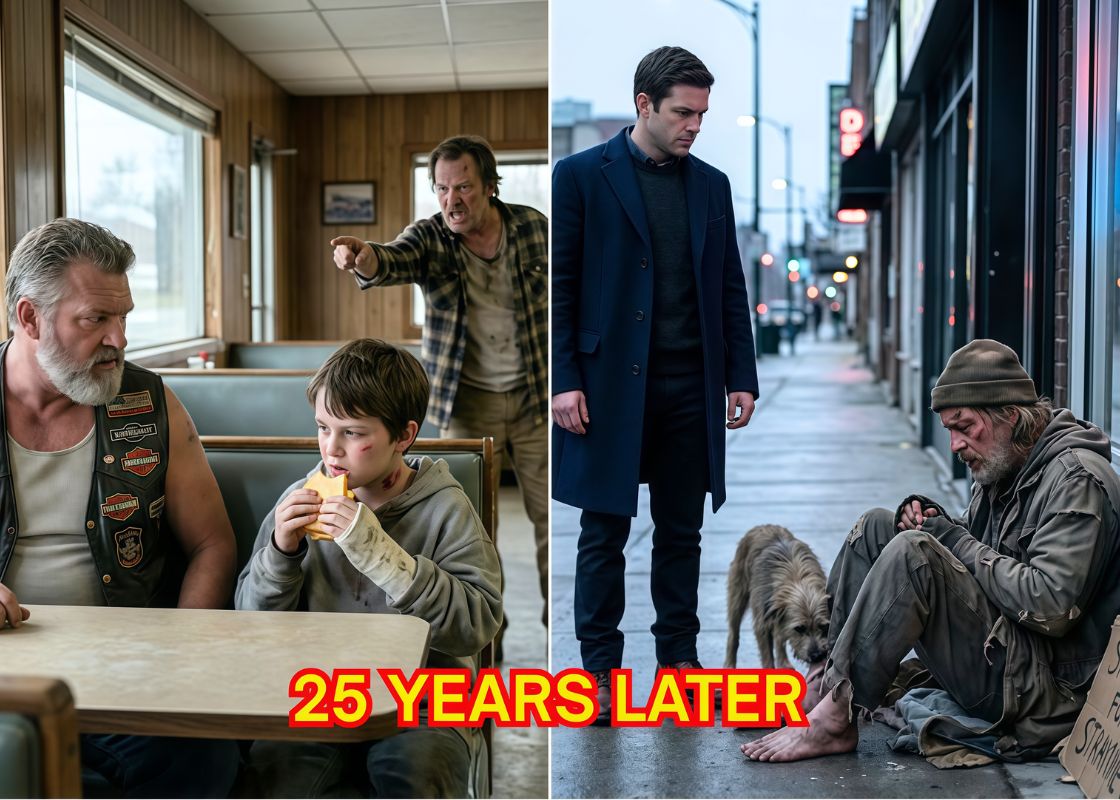
“Can I sit with you?” the boy whispered, clutching a filthy motel key tag so hard his fingers had gone white.
“He said if I die before winter ends, he gets the rest of the money.”
And when I looked up and saw the kind of fear no child should ever carry, I understood something cold and immediate: somebody respectable was hunting that kid, and if I stood up too slowly, he was going to leave that diner in a body bag.
The first thing I noticed was not the cast. It was the way he kept looking at the door like the door had teeth.
Penny’s Harvest Diner was full of the usual late-afternoon drift of Springfield people pretending they had somewhere better to be. Burnt coffee hung in the air. A fryer hissed in the kitchen. Silverware clicked against plates. Outside, the sky over Missouri had that dead gray color that makes every parking lot look tired.
I was in the back corner, where I always sat. Back to the wall. Eyes on the entrance. Chili cooling in front of me. Leather vest over a thermal shirt. Old habits layered over older scars.
My name is James “Iron” Harper, and most people decide what I am before I ever open my mouth.
They see six-foot-four, two-sixty, a beard gone more iron-gray than black, tattoos crawling down both forearms, and a Hell’s Angels patch on my cut, and suddenly they remember an urgent text message or a fascinating napkin crease. I used to resent that.
Then I got older, and I realized fear is at least honest. The bell over the diner door rang, and the whole room barely looked up. I did.
A boy stepped inside like he was crossing enemy territory.
He could not have been more than nine. Thin in the way kids get when food is unpredictable. Hoodie too big. One sneaker untied.
Right leg dragging with a careful, painful hitch. Right arm trapped in a cast so old and grimy it looked less like medical equipment and more like something dug out of a collapsed wall.
He stopped just inside the door and scanned the room. Not like a child looking for a parent. Like a survivor measuring exits. That gets my attention faster than a gun.
He tried the first booth near the window, where two men in high-visibility work shirts were laughing over onion rings. He opened his mouth.
One of them shook his head before the boy even spoke.
“Not now, kid.”
The boy gave the smallest nod I had ever seen, like rejection had become a language he knew too well to argue with, and moved on.
At the next booth, an older woman sat with a grandson about the same age as the boy. She looked up, took in the dirt, the cast, the limp, the hollow eyes, and her hand went straight to her own grandchild’s shoulder.
“We’re waiting on somebody,” she said.
It was a lie so quick and polished it had probably served her well her whole life.
The boy nodded again. At the third booth, three church women in cardigans and pearls didn’t even pretend to consider it.
“One of the staff needs to handle this,” one of them said loudly, as if the child were spilled ketchup. “Where are his people?”
His people.
I watched his face when she said that. No anger. No surprise. Just that same shut-down little stillness people mistake for calm when really it is the body trying to survive humiliation without collapsing.
Then he looked at me. There is a particular kind of look I have seen in places civilians do not understand. In convoy mirrors overseas. In alleys behind roadhouses. In battered women standing barefoot with split lips. In men who know one more wrong move will get them killed.
It is the look of someone who has run out of polite options. He limped toward my table.
Up close, I could see the rest of it. Bruising fading yellow around his throat. A split at the corner of his mouth. Dirt worked deep into the cuff of his hoodie. The cast had softened around the edges from moisture and time.
Under the smell of fryer grease and coffee, I caught the sharper scent of old sweat, wet fabric, and fear.
He stopped beside my table and tried to stand straight.
“Sir,” he said, barely louder than the silverware. “Can I sit with you? Just for a little while. My leg keeps shaking.”
There are moments in life when the right thing does not arrive like thunder. It arrives quietly, in a voice already used to being refused.
Then I pushed the chair out with my boot.
“Sit down,” I said.
His knees gave before he could.
The metal crutch slipped from under his hand and hit the tile with a crack that silenced half the diner. His face went pure white. Not embarrassment. Terror. The kind that says noise brings consequences.
I was up before the chair finished rocking. I caught him under the good elbow, careful, easing instead of grabbing, and lowered him into the seat across from me.
“I got you,” I said.
It came out rougher than I meant it to, but he seemed to hear the part that mattered. He kept staring at the entrance.
I bent, picked up the crutch, leaned it beside him, and flagged Becky “Tina” Mills with two fingers. She had been working Penny’s long enough to know the difference between trouble and danger.
“Grilled cheese,” I said. “Fries. Chocolate shake. Put it on me. Fast.”
Her eyes flicked from me to the boy and narrowed.
“On it,” she said.
The room had started that quiet people do when they want to watch without being seen watching. I ignored them.
The boy’s left hand was buried in his hoodie pocket, fingers clenched around something hard. His right hand, the uncast one, trembled against the tabletop.
“What’s your name, kid?”
He swallowed first.
“Ethan.”
His eyes shifted to me, then away. “Ethan Carter.”
“James Harper.”
A pause.
“I know,” he whispered.
That was not a surprise. In towns like ours, men like me are always known, even by people who have never met us.
“What happened to your arm, Ethan?”
He looked at the cast as if he had forgotten it was there.
“Fell,” he said automatically.
Children say certain lies too fast. You learn to hear the adult inside them.
“You sure?”
He nodded, then shook his head once, tiny and helpless, like the truth had slipped out of his body before he could stop it.
Becky arrived with the shake first. She set it down gently, not asking questions. That told me more than any speech could have. She saw it too.
Ethan stared at the whipped cream like it was an artifact from another civilization.
“You can drink it,” I said.
His hand moved, stopped, moved again. He took one sip and his whole body flinched with the shock of something cold and sweet. It nearly broke me.
“How long you been in that cast?”
He shrugged. “A while.”
“A while like two weeks?”
He shook his head.
“A while like months?”
A smaller nod this time.
“And nobody took you back?”
“My uncle says doctors are expensive.”
There it was. Uncle.
I leaned back slightly, letting him have space while keeping my voice even.
“Your uncle know where you are?”
He looked up so fast I saw the animal panic before he could hide it.
“He’ll find out.”
“When?”
He glanced at the clock over the pie case. 4:42 had become 4:47.
“Before five-thirty.”
The way he said it made my skin tighten across my shoulders.
“Why five-thirty?”
His hand tightened around whatever was in his pocket. The tendons in his wrist stood out.
“He drinks in the afternoons,” he said. “But not all the way. At five-thirty he gets meaner. That’s when he said it would be easiest.”
I did not move. After a long time, I asked, “Said what?”
His eyes filled before the tears came, which is always worse.
“That if I don’t make it through winter, he gets the rest.”
He reached into his pocket and pulled out a brass motel key tag on a cracked plastic diamond. LARKSPUR MOTOR LODGE – ROOM 12.
He set it on the table between us like evidence.
“I heard him on the phone,” he whispered. “He thought I was asleep in the garage. He was talking to some man. He said if it looks like another accident nobody asks questions. He said he already used most of the money and needs what’s left before December.”
The diner around us faded. Not literally. I still heard the fryer. Still saw Becky carrying a pot of coffee to a booth. Still felt the cheap vinyl seat pressing against my thigh.
But the center of the world narrowed to that brass key tag and the child across from me trying not to shake apart.
“What money?”
“My mom and dad’s.”
He said it flatly, like a line memorized under pressure. “They died in a crash two years ago. I was asleep in the back. I woke up in the hospital and Uncle Tommy said I was lucky. Then he said I needed to be good because everything cost money.”
Uncle Tommy – Tommy Nash. I knew the name.
Not personally. Men like him usually avoid men like me in daylight. But I knew the type. Chamber of Commerce smile. Golf shirt respectability. Enough charm to borrow against tomorrow until tomorrow arrived carrying a knife.
“Your full uncle’s name?”
He licked his lip, split it again, winced. “Tommy Nash.”
I took my phone out slowly so he could see exactly what I was doing.
“You calling him?” he asked, voice rising.
“No.”
He watched my face with the frozen intensity of a kid who had learned that adults can turn into threats without warning.
I called Jack “Steel” Mason first. Steel was our chapter president and one of the few men I trust with both my back and my silence. He answered on the second ring.
“What’s wrong?”
No hello. That’s why I called him.
“I’m at Penny’s,” I said. “Got a child here. Nine years old. Neglect, physical abuse, likely attempted murder in progress. Name’s Ethan Carter. Guardian is Tommy Nash.”
Silence for half a beat. Then Steel said, “How many brothers?”
“All the ones who understand this isn’t theater.”
“We’re rolling.”
I ended the call and made two more.
First to Riley “Doc” Bennett, who had once been a combat medic and now ran a discreet urgent care on the edge of town where half the county went when they needed a physician without attitude.
Second to a lawyer named Andrea Givens, a family court attorney who owed Riley a favor and hated child predators with an Old Testament intensity.
Then I called 911. That part matters.
People like to make up stories about men like me, and some of them are earned. But if you want a monster in a pressed vest and expensive truck to stay in prison, you start with the law, not fists.
I reported suspected child abuse, imminent danger, untreated injury, and a minor requesting protection from a legal guardian. The dispatcher’s voice sharpened. Officers were on the way.
Ethan had heard only my side of the calls, but he was smart enough to understand the shape of things. He looked at me like I had just detonated his whole world.
“Are you gonna make me go back with him?”
“No.”
“What if he tells them I lie?”
“Then he tells them that.”
“What if they believe him?”
I reached across the table and laid my hand flat, palm down, not touching him. An offer, not a demand.
“Then they’ll have to do it while I’m still breathing.”
He stared at my hand for a second, then set two fingers against the edge of my knuckle as if testing whether I was real.
The grilled cheese arrived. He ate like every second spent chewing might cost him his life. Becky kept refilling his water without speaking. Once, when she leaned down to set ketchup beside his plate, she saw the bruises on his neck and went still.
Her face changed. Not pity. Resolve. That mattered too.
At 4:56 the first bikes rolled in.
You could hear them before you saw them, a low synchronized thunder moving off the interstate and into the lot.
Through the front windows, chrome flashed under the gray sky. Harleys lined the curb and the long side of the diner, one after another, until the whole place looked less like a restaurant and more like a checkpoint.
The diner reacted exactly how diners always react to a biker convoy. Forks paused. Necks craned. Somebody muttered Jesus under his breath.
Ethan jolted, then looked at me.
“Those are yours?”
“Mine?” I said. “No. I’m not rich enough to own that many motorcycles.”
He almost smiled. Almost.
Steel came in first, broad-shouldered and calm, carrying weather around him like a coat. Hank “Crusher” Ellis followed, then Dylan “Shade” Cole.
Riley Bennett came in a few minutes later in jeans, a flannel, and a medical bag. He looked more like a carpenter than a clinician, which is probably why children trusted him.
Steel took in the scene in one sweep. Me. The boy. The cast. The staring room.
He crossed over and crouched beside Ethan, making a point of lowering himself below eye level.
“Hey,” he said. “I’m Jack.”
Ethan nodded but didn’t speak.
“James says you need some backup.”
Another tiny nod.
“Well,” Steel said, glancing toward the window where more bikes had finished parking, “that can be arranged.”
If the story ended there, it would still have been bad enough. But evil rarely arrives alone. It likes paperwork. It likes timing. It likes to smile.
At 5:07 a black Ford F-150 turned into the lot. Ethan saw it before I did.
His body changed so fast it was like a switch had been thrown under his skin. He slid halfway off the seat, trying to make himself smaller, breath sawing in and out.
“That’s him,” he said. “Please don’t let him take me. Please.”
I stood. So did Steel.
The whole line of brothers outside the diner shifted almost invisibly, not threatening, just present. A wall built out of witness. The truck parked crooked.
Tommy Nash got out wearing dark jeans, a quarter-zip pullover, expensive boots, and the expression of a man who had rehearsed concern in the mirror. Mid-forties, clean-shaven, handsome in a bank-commercial sort of way. The kind of face towns reward. The kind of face juries sometimes trust.
He came through the diner doors with his palms already spread.
“There you are,” he said, voice full of practiced relief. “Ethan, buddy, you had me worried sick.”
He saw me then. Saw Steel too. Saw the cuts, the patches, the size of us, and adjusted.
“Looks like there’s been a misunderstanding,” he said, still smiling. “My nephew has had a rough time since losing his parents. Trauma, you understand. He runs off sometimes and tells stories.”
Ethan made a sound I will never forget. Not a cry. Not a word. Just the sound a child makes when the wolf says his own name kindly.
Tommy moved toward the booth. I stepped into the aisle.
“Don’t.”
His smile thinned.
“I’m sorry?”
“You heard me.”
He gave a small disbelieving laugh and turned it outward, toward the room, toward the audience he thought he still had. “This is absurd. I’m his legal guardian.”
From behind me, Riley spoke for the first time.
“Then your first job as legal guardian was to treat an arm that’s healing wrong and a hip that may not have healed at all.”
Tommy’s eyes flicked to the cast, then back.
“He fell down the basement steps,” he said. “Kids get hurt.”
Steel folded his arms. “And the marks on his throat?”
Tommy did not look at Ethan.
“That boy bruises easy.”
I saw Becky at the coffee station with her phone angled low, recording.
Tommy noticed the bikes through the front window and finally understood he was not dealing with one old biker and a bad day. He was dealing with a room that had chosen a side before he got there.
His tone cooled.
“You people have no idea what you’re stepping into.”
“No,” I said. “You don’t.”
Then he made his mistake. He looked directly at Ethan and said, very softly, “Get over here. Now.”
It was too controlled. Too familiar. Too full of private punishment. Several people in the diner who had been trying not to involve themselves visibly recoiled.
Becky walked out from behind the counter and planted herself near the register.
“He stays seated,” she said.
Tommy turned to her, surprised that the waitress had become a person.
“This is family business.”
Becky crossed her arms. “It became everybody’s business when a child walked in here looking like that.”
That was our unexpected ally, though I did not know it yet.
Tommy took one more step and reached toward the booth. I caught his wrist. Not hard enough to break anything. Hard enough to make his eyes change.
“Touch him,” I said, “and you will regret the mathematics of it.”
He yanked back. “Assault. Great. Thank you. Half this room just watched you assault me.”
“Actually,” Becky said, raising her phone, “half this room just watched you threaten a kid.”
His face turned. The first patrol car hit the lot with lights but no siren. Then another.
What happened next is where most stories cheat. They turn the police into immediate heroes or immediate villains depending on what makes the audience feel righteous. Real life is uglier and slower. Real life makes you prove what the child already knows.
The deputies came in alert, hands near belts, taking in the bikes first, then us, then Tommy, who straightened his posture by half an inch and put on his grief.
“Thank God,” he said. “My nephew has been manipulated by these men. He’s confused. He ran away.”
One deputy, older, tired-eyed, looked at Ethan and did not answer right away.
The younger one asked, “Who called?”
“I did,” I said.
Tommy pounced on that. “Of course he did. Look at them. This is intimidation. My nephew’s been through trauma. He needs stability, not vigilantes.”
Then Riley stepped forward, opened his bag, and handed over a card with his full credentials.
“Riley Bennett, PA-C. Former military medic. I performed a visual trauma assessment here in the diner. That child needs immediate hospital evaluation for suspected medical neglect, untreated fracture complications, and repeated physical abuse.”
Andrea Givens came in almost on cue, hair damp from the rain, briefcase in hand, expression sharp as broken glass.
“And I’m counsel retained for the emergency protection of the child,” she said. “If anyone is considering releasing him back into the custody of Mr. Nash before medical imaging, forensic photographs, and a protective interview, I strongly advise against it.”
Tommy blinked. He had not expected lawyers. He had definitely not expected one wearing a camel coat and carrying a family court emergency packet already half-completed.
Andrea moved fast. She always had. She asked Ethan two direct questions in front of the deputies: Did he feel safe leaving with Tommy Nash? Had Tommy Nash threatened him or made him fear he would be injured again?
“No,” Ethan said to the first.
“Yes,” he said to the second.
His voice shook but it did not break.
Andrea looked at the deputies. “That is enough for immediate protective action while the facts are sorted.”
Tommy laughed once, brittle. “This is insane.”
Then Becky spoke again.
“I’ve got security footage from the front camera, side camera, and register camera. It shows the child entering alone, attempting to get help, being unable to stand, and you coming in here acting like you already knew exactly where he was.”
That landed.
So did the church lady in pearls, who stood up red-faced and said, “The boy asked for help. We all heard him. He looked terrified of that man.”
Sometimes people find their conscience only after someone else has made bravery look embarrassing. I did not care why. I cared that it was happening.
The older deputy looked at Tommy and said, “Sir, I’m going to need you to step outside.”
Tommy’s mask slipped all at once.
“This is my nephew. Do you know who I am?”
The deputy’s expression did not change. “Outside.”
Tommy pivoted toward Ethan then, and there it was at last, the real man under the community-sponsor smile. “You ungrateful little”
He stopped because Steel moved. Not touched him. Not threatened him. Just moved half a step forward. Tommy went silent.
Ethan was transported to Mercy Hospital under protective hold. Riley rode in the ambulance. I followed on my bike. Steel took charge of the diner, coordinated statements, copied footage, and made sure Tommy Nash did not disappear before detectives got there.
At the hospital, things turned worse and clearer.
The cast had been left on too long. The fracture had started healing wrong. The hip injury was older than Tommy had claimed and consistent with a hard push or fall, not a simple stumble.
There were bruises in different stages of healing along Ethan’s ribs and upper arms. Malnutrition markers. Sleep deprivation indicators. The ER physician’s face hardened with every chart note.
Then came the photograph session. The forensic nurse was gentle. Ethan was not used to gentle.
He clutched the edge of my vest while she documented the thumbprint bruising on his neck. At one point he looked up at me and whispered, ashamed, “I smell bad.”
I had to look away for a second.
“You smell like a kid who got through the day,” I said. “That’s all.”